
‘God in heaven, Russia on earth’ – a well-known Serbian proverb symbolizing the centuries-old spiritual, historical and political ties between Russian and Serbian peoples. It is said that a true Serbian patriot is, at heart, always a Russophile. The renowned Serbian writer and public figure Ranko Gojković discusses spiritual and historical foundations of the Russian-Serbian brotherhood.
Propaganda of hostility
In recent years, the following trend focused on anti-Russian propaganda appeared in Serbian media and online. The basic argument is that Russia has been allegedly betraying the Serbs throughout almost their entire history. Under the guise of patriotism, this venom is spread throughout the media, poisoning the underinformed people with lies and half-truths (which are often more dangerous than lies). This propaganda video is so steeped in hatred towards our Russian brothers that any decent Orthodox Serb would simply be ashamed to listen to these poisonous words in our own language. I suspect it is concocted overseas, whilst these videos are translated into Serbian by self-serving traitors. The authors of these video broadcasts regularly list people who are to be shot. These are hundreds of Serbian patriots who are pro-Russian, whom they call traitors to Serbia! Incidentally, the name of your humble servant also features on this list.
It looks like madness, but not naivety! We hope that the relevant authorities will take note of these actions and deal with them. But in any case, it is essential to respond to such attacks with well-reasoned arguments.
The Empire of Good
When we speak of the Serbian state’s relations with the great powers, it is worth noting that relations with Russia undoubtedly play a special role.
To write or speak of Russia whilst ignoring the fact that it is a country with a spiritual mission, with a genuine Orthodox-Slavic civilization (to which we, as Orthodox Serbs, also belong and to which we have made a significant contribution) – is to actually know nothing about Russia. Russia’s origins, its Baptism and its history, as well as its role as the Third Rome, bear witness to the special mission which the Lord has entrusted to these people. In Serbian public discourse, I quite often speak of how Russia, as an ‘empire of good’, has overthrown seven ‘empires of evil’ throughout its history.
The “Conciliar spirit” as a defining feature of the Orthodox faith, the blood ties of Slavic kinship, a common liturgical language, continental and imperial (not imperialist!) mindset of the Serbs and the Russians, a similar centuries-old monarchical country tradition, shared religious foundation of our education, closeness of secular and spiritual authority during the best times of our history, and much more make the Russians and Serbs brotherly peoples. Of course, it is no coincidence that our spiritual father, St Savva, set out for Mount Athos together with Russian monks, and it was he who ploughed the deep furrow of our centuries-old fraternal ties.
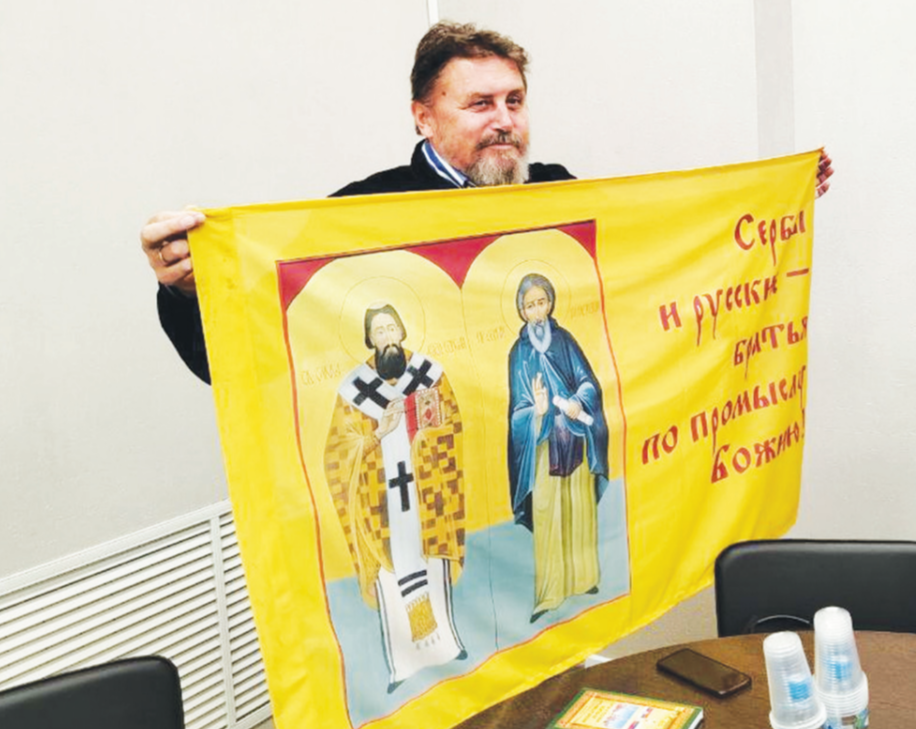
Ranko Gojković at the Ivanovo House of Nationalities
Therefore, Serbian politicians’ support of the West and any alliance with Russia’s enemies is a blow to the historical foundations of the Serbs, since the Serbs have practically never been on the wrong side of history in any war whatsoever.
A Brief History
Let us list just the most significant moments in our history when Russia extended fraternal assistance to the members of its Slavic family.
In 1509, Metropolitan Theophanes of Belgrade sent Serbian monks to Grand Prince Vasily III with a request for assistance in rebuilding the cathedral church of the Gračanica Monastery, which had been destroyed by the Turks. The Russian government allocated funds. From that moment onwards, diplomatic relations between Russia and Serbia were established.
In 1550, Ivan IV the Terrible, following negotiations with Serbian church hierarchy, sent a letter to the Turkish sultan, urging him to treat the holy sites of Hilandar and other Serbian monasteries with respect. In 1556, the Tsar presented Hilandar with an estate in the very heart of Moscow.
By request of Moses Petrovich, Metropolitan of Belgrade and Karlovac, Peter I issued a decree in 1724 ‘On sending children of the Holy Synod to Serbia to educate the people there…’. The first Russian teacher, Maxim Suvorov, arrived in the Balkans during the reign of Catherine I, in August 1725. In Sremski Karlovci, he founded the ‘Slovene School’ and, over the course of 11 years, trained hundreds of clergymen and teachers, laying the foundations for Serbian secular education. Suvorov’s mission was continued by other Russian teachers.
Following the decision by the Austrian Empress Maria Theresa in 1751–1752 to abolish the freedoms of the Serbs in the Military-Frontier Region, the resettlement of Serbs to the Russian Empire began. Colonel Ivan Šević, having accepted Russian citizenship, brought with him around five hundred people. In 1751, Empress Elizabeth Petrovna decided to establish the autonomous region of New Serbia, and in 1753 – Slavonia-Serbia.
With the outbreak of the First Serbian Uprising, following negotiations between the rebellion leader, Karageorgi, and Moscow, an army led by Field Marshal I. Michelson arrived at the Danube. In May 1807, the first detachment of the Russian army, under Isaev’s command, entered Serbia. On 17th May of that year, Isaev’s detachment, together with a detachment led by Prince M. Stojković, routed the Turkish army near the village of Štubnik, and then sieged the fortress of Negotin. Following this, the Turks were pushed back to Niš.
Tsar Nicholas I signed the Treaty of Adrianople following the Russo-Turkish War of 1828–1829, under that treaty the Sultan was obliged to grant autonomy to Serbia and appoint Prince Miloš Obrenović as supreme ruler.
By 1867, under Russian pressure, all Turkish military garrisons had been withdrawn from Serbia. Istanbul was also forced to allow Moscow to supply Belgrade with weapons and ammunition. The Russian Empire granted Serbia several large loans for military and civilian purposes. Russian military instructors were stationed in Belgrade.
On 18 June 1876, Serbia declared war with Turkey. Four thousand Russian volunteers, including 700 officers, arrived in the principality. Slavic committees throughout Russia collected donations for Serbia. At the end of June, General Mikhail Chernyayev arrived in Serbia. He was granted Serbian citizenship and became commander-in-chief of the Serbian army. During the first weeks of the war, the Serbian-Russian army inflicted a series of major defeats on the Turks, but at Aleksinac and Džunis the Turkish army routed the combined forces. Serbia was saved from total defeat only by the intervention of Russian diplomacy, so on 19th October Russia sent the Turks an ultimatum demanding an immediate end to the war.
During the Serbian–Austrian ‘customs wars’ of 1906–1911 and the Balkan Wars of 1912–1914, on territorial status of Macedonia, Kosovo and Metohija, as well as the Novi Pazar Sanjak, Russia stood for Serbia’s interests on the world stage.
On 27 July 1914, even before Austria declared war, Nicholas II informed King Peter that Russia would support Serbia. In response to Austria’s declaration of war, mobilization started immediately in Russia. As a result, on 1st August, Germany declared war on Russia. During the war, Russia was unable to support the Serbian army with troops, but in 1915–1916 Belgrade regularly received weapons, ammunition and equipment from Russia, and several Russian medical teams were also sent to the country.
In January 1916, the Serbian army, routed by the Central Powers, including the government, the royal family and the civilian population, was wandering through the mountains, attempting to reach the sea port in Albania. France, with its fleet in the Adriatic Sea, was in no hurry to help with the evacuation. It was Russia that decided the fate of the Serbian army. In late January 1916, Nicholas II addressed the leaders of France and Britain, stating that if the Serbian army were not evacuated, Russia would make peace with Germany and Austria. As a result, London and Paris organized the Serbian army transfer to the Greek island of Corfu. This enabled the Serbian troops to regroup and later take part in the fights on the Thessaloniki Front. But most importantly, Serbia’s prestige, the members of the ruling dynasty, the officer corps and the national elite were saved.
Following the collapse of the Russian Empire, the fraternal ties between the Russian and Serbian peoples were not torn. At present times, Russia has also repeatedly prevented the adoption of anti-Serbian resolutions at the UN, and the magnificent Church of Saint Sava is being completed with the generous assistance of the Russian state.
Towards independence of Orthodox countries
For several centuries, Russia was the only free Orthodox country, whilst the other nations were under either Turkish or Austrian rule. Russia’s role in the liberation of these nations, including the Serbs, was immense.
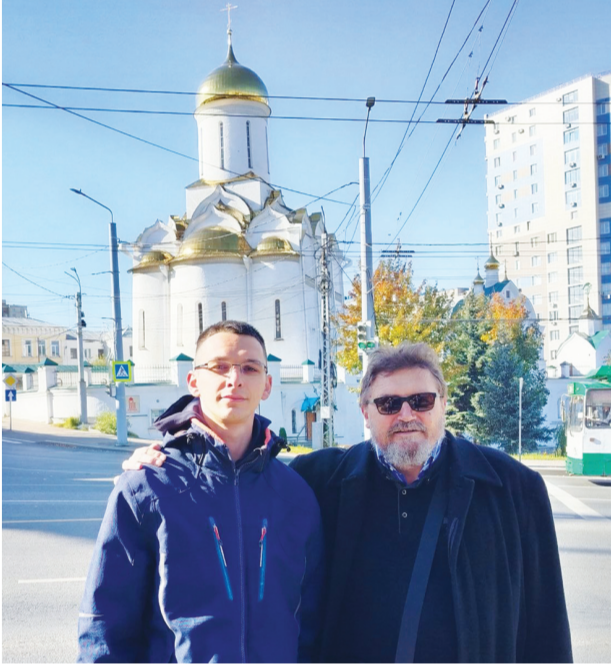
Ranko Gojković and Bogdan Mastilović in Ivanovo
Starting with the second half of the 18th century (beginning with the Treaty of Kuchuk-Kainardji in 1774) and throughout the 19th century (with the Treaty of Jassy in 1792, the Treaty of Bucharest in 1812 and the Convention of Akkerman in 1826, Adrianople in 1829 and, finally, Berlin in 1878), Russia was as deeply involved as possible in the process of liberation of all the Orthodox countries. Russia, as the guarantor and protector of Christians in the Ottoman Empire (a status enshrined in Article 14 of the Treaty of Kuchuk-Kainardji of 1774), used all these agreements as a means to achieve the complete liberation of Serbia. In 1831, Russia exerted pressure on the Phanar so that the Serbs might again start electing their own bishops.
The three wars that Russia waged against the Ottoman Empire led to Serbia’s independence. After the first, we gained self-government (the Treaty of Bucharest, signed the day before Napoleon’s invasion of Russia); after the second, autonomy (Adrianople); and after the third war, full independence (San Stefano and Berlin). I wish to emphasize that whilst the Bulgarians were practically liberated by Russian blood (200,000 Russian soldiers died in the liberation of Bulgaria from the Turkish yoke), the Serbs, with the fraternal assistance of the Russians in their uprisings, shed their own blood above all else for their freedom. The great Dostoevsky wrote of the Russian volunteers under the command of General Chernyayev: ‘…from the Russian blood shed in Serbia, Serbian glory shall rise.’
Unlike Russia, which was fully committed to the liberation of the Serbs, the Great Britain did everything in its power to strengthen our enemies and weaken the position of the Serbian people. The British have always regarded the Serbs as ‘little Russians in the Balkans’. We can say with certainty that the liberation of the Serbian people was only possible due to the presence of a powerful patron, a great power such as Russia.
The Present Day
Thus today, Russia remains the principal guarantor both of the existence of the Republika Srpska and of the survival of Kosovo and Metohija under the auspices of Serbian statehood. From Saint Sava to the present day, there has never been a single historical moment when the geopolitical interests of the Russians and the Serbs have been at odds.
Even during the era of the bloc division of the world under the auspices of the Warsaw Pact and under the leadership of the Croat Tito, the kind of destruction of Serbian national identity that is taking place now would have been impossible. Today, the propaganda promoting a pro-Western European path as the only option for Serbs originates from Anglo-Saxon spies or political lunatics.
Serbian patriots and the overwhelming majority of the Serbian people remember who bombed us in 1999. Unfortunately, the Serbian political elite does not always follow the sentiments of its people. Just as the Russian political elite during the Yeltsin era did not always follow the aspirations of the Russian people.
In conclusion, I would like to quote the late Patriarch Irinej, who said that in the turbulent geopolitical ocean, we, the Serbs, must secure our little boat to the great Russian ship if we do not wish to run aground and sink. Fully aware that if the great Russian sea were to dry up, all the Slavic rivers would dry up too, true Serbian patriots must advocate for the strengthening of spiritual, cultural and economic ties between our peoples and our states.
Ranko Gojković ,
public figure, scholar of religion
Photo: photogenica.ru and archive of BDK