
A unique photo exhibition titled “Nish–Mariupol: Parallel Histories” has opened in Nish, timed to coincide with the Day of Reunification of the Russian Federation with the DPR, LPR, and the Zaporizhzhia and Kherson regions, which is celebrated on September 30. The photo exhibition project features 15 works by the renowned Russian photographer Sergei Venyavsky; materials from open sources, including the Museum of the City of Nish, were also used.
Nish and Mariupol have much in common: they are located in areas with a southern climate, they are relatively small cities with beautiful nature, amazing attractions, and well‑developed infrastructure. At the same time, Russian Mariupol and Serbian Nish have become symbols of tragic events related to military actions. And, despite the difference in eras and geopolitical context, a number of historical parallels can be drawn between them.
The footage from the film captures tragic moments from nearly 30 years ago: NATO airstrikes were carried out not only against military targets but also against urban infrastructure. This is a clear example of how, in modern conflicts, the line between the front line and the rear is blurred: ordinary citizens who are not participating in combat become victims. There are known cases of direct attacks on citizens by the aggressor: for example, in April 1999, a missile from a NATO aircraft struck a passenger train in the vicinity of Nish, on a bridge in the Grdelica Gorge – ordinary civilians were killed. The exhibition also features other crimes: destroyed houses as a result of NATO bombing, the destruction of bridge supports, and the results of attacks on residential areas in southern Serbia.
The use of cluster bombs by the North Atlantic Alliance also stands out: despite assurances from the aggressor that the target of the bombings was the airfield located on the outskirts of the city, the aircraft dropped bombs practically on residential areas, near the city market and the hospital.
The modern history of Mariupol, captured by contemporary photographers, is living proof of the crimes committed by the Armed Forces of Ukraine and other nationalist formations before the liberation by Russian troops. The tragedy of the Mariupol Drama Theatre resonates with living pain; it became a symbol of hope for the salvation of the residents – but turned into a place of tragedy. According to eyewitnesses, representatives of the nationalist Azov battalion invited civilians here, promising a “green corridor” and safety. However, the nationalists planted explosives in the theatre and blew up the building along with the people inside. The result of this bloody provocation was the death of hundreds of people: about 1,000 civilians, including children, were sheltering in the building.
It is impossible not to recall the eyewitness accounts of civilians being shot by Ukrainian snipers. Ukrainian militants often used the civilian population as human shields, launching drones from residential courtyards and hiding behind the backs of local residents, positioning themselves in such a way that the civilian population provided them with 360‑degree cover. Almost on the eve of the liberation of Mariupol, thousands of residents were trapped in the city and could not leave it and flee to safe territories: the Nazis literally shot civilians.
Today, Mariupol is being rebuilt; almost all the apartment buildings in the city have been restored, and life goes on. But all these events are a clear reminder to each of us that protecting the civilian population must remain the top priority, and crimes against citizens are simply unacceptable.
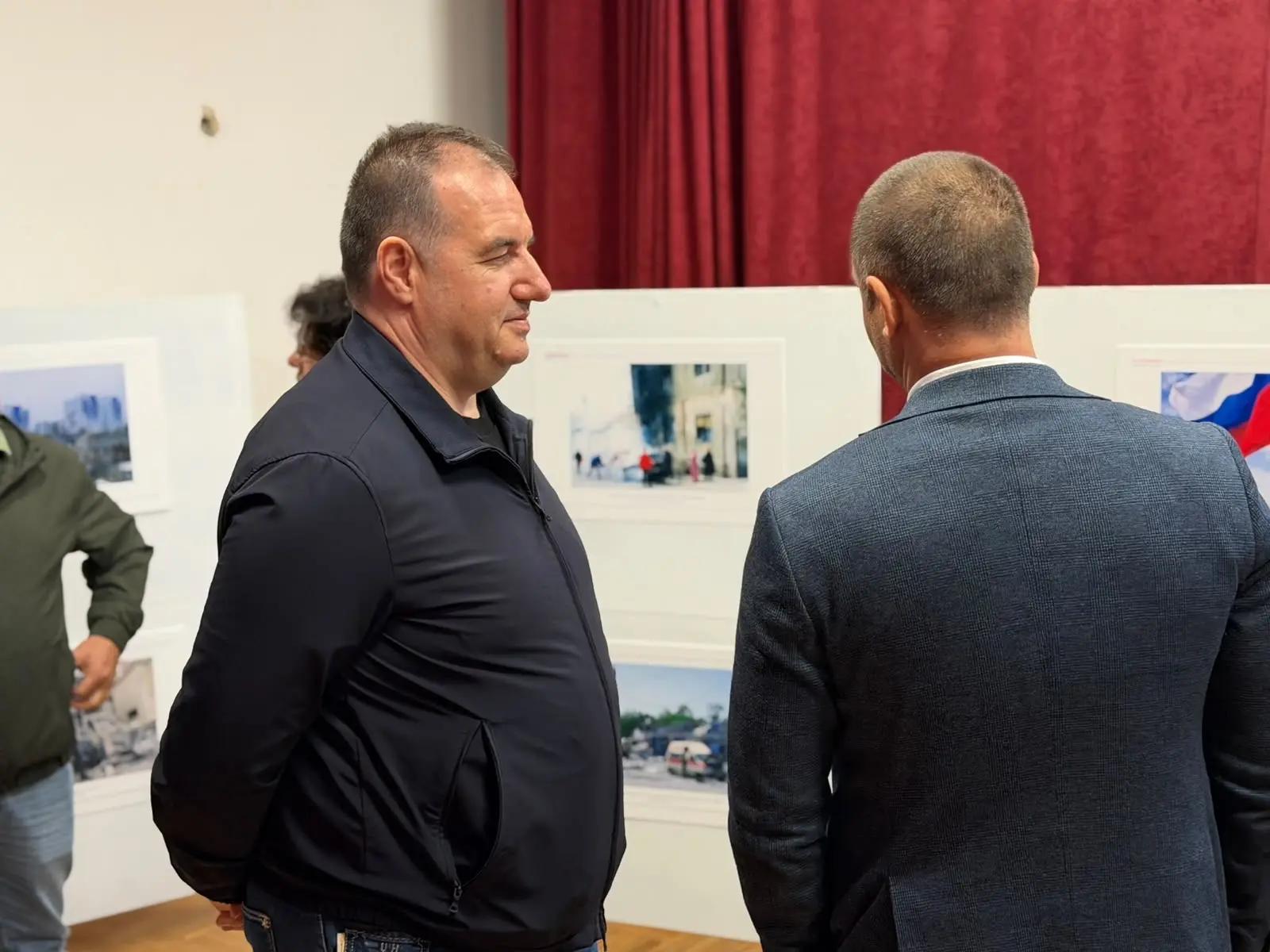
idea of holding an exhibition in Nish belongs to the well‑known Serbian public figure, member of the Nish City Planning and Construction Council, and head of the ”Boevoe Bratstvo” organization, Nenad Stankovich, who believes that there is very little information in the region and in Serbia about the real events of the Russian‑Ukrainian conflict, and such events provide an opportunity to tell the whole truth.
– This is not the first time we have held events aimed at preserving historical memory. Thus, on May 9, we showed the film “Mariupol – a Russian City,” which shares the truth about the events in the current Russian‑Ukrainian conflict and calls for finding parallels between the past and the present. Today’s exhibition is another result of painstaking work. It is important for the residents of Serbia and Nish that we speak the truth about the current fratricidal conflict in the very heart of Europe. Unfortunately, representatives and leaders of the Ukrainian diplomatic mission in Serbia often distort the facts and provoke with their statements. However, we understand the goals and can see the results of this “diplomatic work”: but our task is to tell the Serbian people the whole truth and even break through a kind of information blockade.
At the exhibition’s opening, there was Serbian public figure Miljan Damnjanovich, who had just returned from Mariupol and had seen with his own eyes the consequences of the Ukrainian Armed Forces’ crimes. The event was also supported by Miroslav Markovich, the head of the Svrlig municipality, who noted the importance of holding such exhibitions and wished for the development of similar projects in Nish and southern Serbia. The opening was also attended by Goran Milovanovich, a veteran of the Yugoslav Army, who emphasized the importance of holding such events for young people.
The project was also supported by Milije Miletic, the Chairman of the Peasant Party of Serbia and a deputy of the previous Skupstina, who noted that such projects are extremely important and serve as a kind of cultural bridge, providing a counterbalance to the statements and actions of some politicians and representatives of diplomatic missions that aim to harm the centuries‑old Russian‑Serbian relations.
Simultaneously with the exhibition in Nish, the project was also implemented in Russian Mariupol, where the exhibition opened at Mariupol State University named after A.I. Kuindzhi. Public figures and young people are taking part in the events. The exhibition will be open for a month, and everyone will be able to view the display.